
Overcoming Imposter Syndrome as a New Executive: A Strategic Framework
Did you know that 71% of CEOs admit to experiencing imposter syndrome? Despite your hard-earned seat at the table, you might feel like your promotion was a fortunate accident rather than a result of your expertise. Overcoming imposter syndrome as a new executive isn’t about ignoring these feelings; it’s about closing the “growth gap” between your current self-perception and your new professional reality. It’s common to find yourself overworking to compensate for perceived inadequacy or second-guessing decisions that used to feel intuitive.
You deserve to lead with the same clarity and purpose that earned you this role. We’ll show you how to transform leadership anxiety into a powerful catalyst for high-performance executive presence. This article provides a strategic framework to help you reduce burnout and cultivate a quiet, authentic confidence in the boardroom. It’s time to stop performing and start leading.
Key Takeaways
- Reframe self-doubt as a predictable “growth gap” that occurs when your professional status evolves faster than your internal self-perception.
- Learn how high achievers can underestimate their value, turning perceived weaknesses into indicators of potential.
- Utilize the “Evidence File” technique to create a data-driven record of your successes, helping you separate objective facts from temporary feelings of inadequacy.
- Discover a proven roadmap for overcoming imposter syndrome as a new executive by auditing your internal narrative and identifying specific “fraud” triggers.
- Understand how executive coaching provides the necessary structure to bridge the gap between leadership anxiety and authentic presence.
The Invisible Barrier: Why New Executives Experience Imposter Syndrome
The path to overcoming imposter syndrome as a new executive begins with a clear definition of the challenge. It isn’t a personality flaw; it’s a specific psychological pattern of doubting one’s accomplishments that creates a profound gap between your internal self-perception and your external professional status. You’ve been promoted based on a track record of excellence, yet you find yourself questioning if you’ve simply been lucky or if the hiring committee missed a critical flaw. This dissonance is common, but it’s often kept secret, which only serves to strengthen its grip on your leadership style.
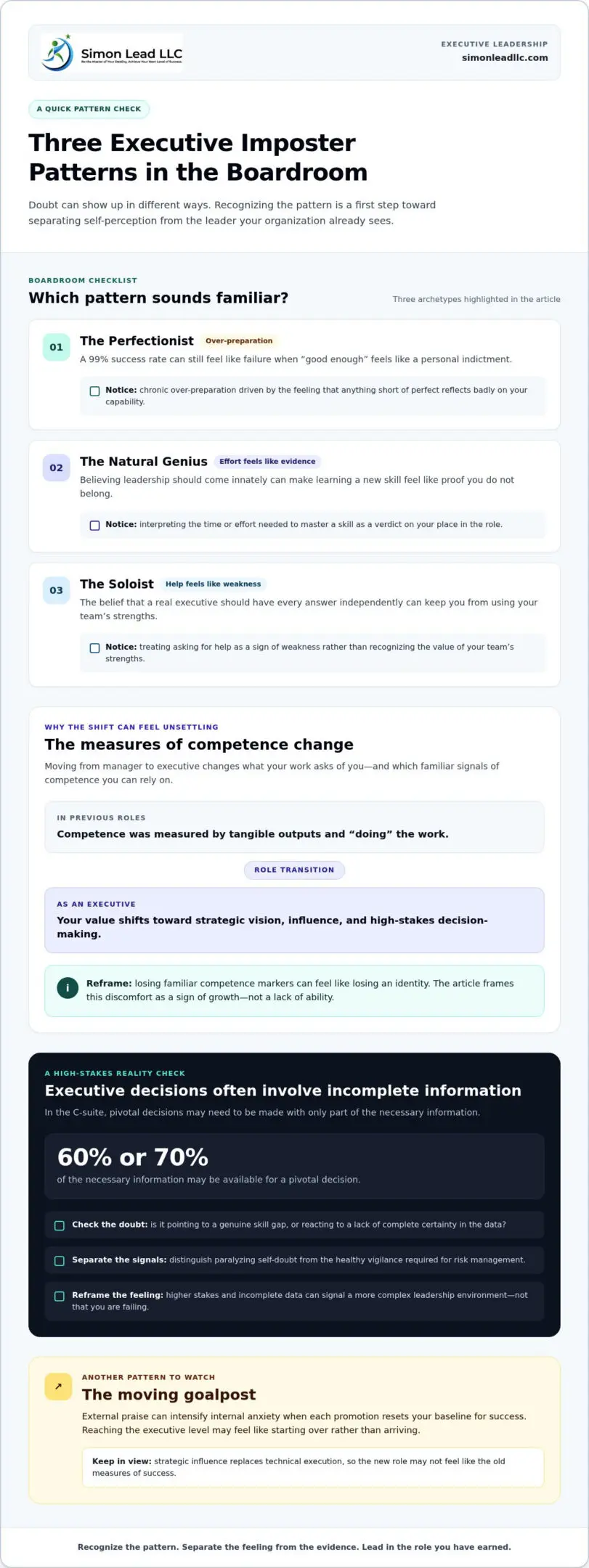
The transition from manager to executive is the most frequent trigger for these feelings. In your previous roles, competence was measured by tangible outputs and “doing” the work. As an executive, your value shifts toward strategic vision, influence, and high-stakes decision-making. This loss of familiar competence markers can feel like a loss of identity. You might even fear the Peter Principle has finally caught up with you, convincing yourself that you’ve reached your level of incompetence. It’s vital to recognize that this discomfort is actually a sign of growth, not a lack of ability.
The Psychology of the Executive Transition
Stepping into a public-facing role fundamentally changes your internal psychological safety. Suddenly, your decisions carry immense weight, and your mistakes are visible to the entire organization. This high-stakes vacuum is often exacerbated by the inherent isolation of leadership. When you have fewer peers to consult, your internal critic becomes the loudest voice in the room. If left unaddressed, this self-doubt creates an organizational ripple effect. A hesitant leader slows down innovation, delays critical pivots, and inadvertently signals instability to the team, creating a “cost of silence” that impacts the entire company culture.
Identifying the Five Executive Imposter Archetypes
Understanding how your doubt manifests is essential for professional evolution. While several variations exist, three archetypes frequently appear in the boardroom:
- The Perfectionist: You view a 99% success rate as a failure. For you, “good enough” feels like a personal indictment of your capabilities, leading to chronic over-preparation.
- The Natural Genius: You believe leadership should be innate. When you encounter a skill that requires effort or time to master, you interpret the struggle as proof that you don’t belong in the role.
- The Soloist: You subscribe to the dangerous myth that asking for help is a sign of weakness. You believe a real executive should have all the answers independently, which prevents you from utilizing your team’s strengths.
Recognizing these patterns is the first step toward overcoming imposter syndrome as a new executive. By externalizing these thoughts, you can begin to bridge the gap between who you think you are and the leader your organization already sees.
Deconstructing the “Fraud” Myth: The Psychology of High-Stakes Leadership
The path to overcoming imposter syndrome as a new executive begins with a fundamental reframe: your feelings of inadequacy aren’t a pathology, but a byproduct of your excellence. High achievers often underestimate their abilities because their skills have become so familiar that they overlook the expertise behind their results. You perform at such a high level so naturally that you assume your success is accidental or easily replicated by others. In reality, your promotion is evidence of a sophisticated skill set that your organization desperately needs.
In the C-suite, you’re frequently forced to make pivotal decisions with only 60% or 70% of the necessary information. This inherent ambiguity triggers the “fraud” reflex because you’re used to being the subject matter expert with all the answers. Recognizing that your “fraud” feelings are actually a growth indicator signals that you’ve entered a tier of leadership where the stakes are higher and the data is naturally incomplete. You aren’t failing; you’re simply learning to operate in a new, more complex environment.
The Feedback Loop of High Achievement
Paradoxically, external praise can intensify internal anxiety for new leaders. When your board or peers celebrate your visionary decisions, your internal critic may whisper that they simply haven’t seen you fail yet. This is the “Moving Goalpost” phenomenon where each promotion resets your baseline for success. Reaching the executive level often feels like starting over rather than arriving at a destination. You’re navigating a new ecosystem where strategic influence replaces technical execution. If you’re feeling the weight of this transition, engaging in executive coaching can help you align your internal self-perception with your external reality.
Reframing Anxiety as Strategic Alertness
True leadership isn’t the absence of fear; it’s the presence of strategic alertness. You must learn to distinguish between paralyzing self-doubt and the healthy vigilance required for risk management. Use that “imposter voice” as a diagnostic tool. Is it signaling a genuine skill gap, or is it merely reacting to the lack of 100% certainty in your data? By externalizing this dialogue, you turn a psychological burden into a roadmap for professional development. Listen to what the doubt is actually saying; it might be highlighting a need for better assessments to ground your decisions in objective data. Executive presence is the ability to lead through uncertainty without feigning perfection.
Cognitive Reframing: Distinguishing Growth Pains from Lack of Competence
Many leaders wait for self-doubt to vanish with time, but passive waiting often leads to entrenched burnout. Active cognitive reframing is the essential tool for overcoming imposter syndrome as a new executive. This process requires you to distinguish between genuine “technical gaps” and “confidence gaps.” If you lack specific knowledge in a new functional area, such as complex capital structures, you face a technical gap that requires targeted training. However, if you possess the skills but live in fear of being “exposed,” you’re dealing with a confidence gap that requires coaching and objective data to resolve.
One of the most effective methods for grounding your self-perception in reality is the “Evidence File” technique. This involves maintaining a systematic record of measurable leadership results, such as successful strategic pivots, high-stakes negotiation wins, or positive organizational health metrics. When the inner critic suggests you’re unqualified, you don’t argue with feelings; you respond with documented facts. This data-driven approach shifts your internal narrative from subjective anxiety to objective authority, making your transition sustainable.
Healthy Humility vs. Destructive Self-Doubt
It’s vital to recognize that a total absence of self-doubt might actually signal a lack of self-awareness. The goal isn’t to become arrogant, but to find the “sweet spot” where humility meets authority. Consider these distinctions to evaluate your current standing:
- Healthy Humility: You are open to feedback because you’re focused on the organization’s mission. You see mistakes as data points for improvement and evolution.
- Destructive Self-Doubt: You’re crushed by criticism because you view it as proof of your fundamental inadequacy. You see mistakes as personal failures that threaten your professional standing.
Leveraging Leadership Assessments for Objectivity
Internal bias often distorts how you view your own performance. Professional Leader and Team Assessments act as a high-definition mirror, providing the objective data needed to silence the inner critic. By utilizing 360-degree feedback, you gain a clear view of how your peers, board, and subordinates actually perceive your impact. This external validation often reveals that your perceived weaknesses are either non-existent or far less significant than you imagine. These assessments serve as the foundation for a personalized leadership development plan, ensuring that your growth is based on strategic reality rather than psychological shadows. Utilizing these tools is a hallmark of overcoming imposter syndrome as a new executive, as it replaces guesswork with measurable clarity.
A Roadmap to Executive Presence: Practical Strategies for Sustainable Confidence
Transitioning from cognitive reframing to daily practice requires a tactical sequence of actions. First, you must audit your inner narrative to pinpoint specific “fraud” triggers, such as high-stakes board meetings or complex financial reviews. Once these triggers are identified, you can externalize the internal dialogue through Executive Coaching. This process moves the doubt from a private psychological burden into a collaborative, professional space where it can be analyzed and dismantled. It’s about taking the power away from the “imposter voice” by subjecting it to the light of objective scrutiny.
The third step is a fundamental shift in focus from self-evaluation to service. When you stop asking, “Am I good enough?” and start asking, “How can I best serve my team today?”, you remove the ego from the equation. This leads to the fourth step: building a “Kitchen Cabinet” of three to five trusted, objective advisors who understand the nuances of the C-suite. Finally, implement a structured leadership framework to guide your daily decisions, ensuring that your leadership is grounded in strategy rather than fleeting feelings of inadequacy.
The Power of Strategic Vulnerability
Authority isn’t synonymous with omniscience. In fact, admitting “I don’t know” can actually build deeper team trust and authority because it demonstrates intellectual honesty. Sharing your growth journey with your executive team humanizes your leadership and models a culture of continuous improvement. The key is maintaining the distinction between strategic vulnerability and over-disclosing personal insecurities. You’re sharing the process of professional evolution to empower others, not inviting the team to manage your internal anxiety. This balance is critical for overcoming imposter syndrome as a new executive while maintaining your professional gravitas.
Developing a “Bias for Action” to Combat Over-Analysis
Imposter syndrome often manifests as analysis paralysis, where the fear of making a visible mistake leads to delayed pivots and missed opportunities. Overcoming imposter syndrome as a new executive requires developing a “bias for action,” which is the commitment to momentum over perfection. You must learn to make confident decisions even when you have incomplete information. The 80/20 rule for executive decision-making speed dictates that once you have 80% of the necessary data, the cost of further delay is higher than the risk of an imperfect choice. This shift from over-preparation to decisive execution is what ultimately builds sustainable executive presence.
Accelerating Your Transition: The Role of Executive Coaching
The final stage of your transition involves moving beyond the psychological hurdles and into a state of optimized performance. Executive coaching serves as the primary catalyst for this evolution, transforming you from a “New Executive” into a truly “Strategic Leader.” It’s a common mistake to view coaching as a remedy for a problem. In reality, the most resilient leaders recognize it as a prerequisite for excellence. By engaging in a structured Coaching Package, you’re not just managing self-doubt; you’re actively accelerating your integration into the C-suite and ensuring better organizational alignment. The return on investment for overcoming imposter syndrome as a new executive is measured in the clarity of your decisions and the speed at which you drive change. Are you leading from a place of reaction, or are you operating from a position of strategic intent? This distinction often determines the long-term sustainability of your influence.
Your First 90 Days and Beyond
The first three months of your tenure are critical for setting the tone of your leadership. During this window, your team and board are looking for signals of stability and vision. Coaching provides the objective distance necessary for honest growth, allowing you to process challenges without the bias of internal office politics. It functions as your secret weapon, providing a safe harbor to refine your executive presence before you step into the boardroom. This period of rapid evolution requires a guide who has navigated these complexities before. It ensures that your leadership transition is not just a survival exercise, but a launchpad for long-term influence. If you’re ready to bridge the gap from anxiety to authority, schedule a complimentary consultation to explore your personalized development plan. Taking this step confirms your commitment to professional excellence and organizational health.
Step Into Your Authentic Authority
The transition into executive leadership is a profound evolution that demands more than just technical skill; it requires a complete recalibration of your internal narrative. By shifting your focus from self-evaluation to strategic service and grounding your decisions in objective data, you replace the vacuum of doubt with a foundation of clarity. Overcoming imposter syndrome as a new executive is not a matter of waiting for confidence to arrive, but of actively implementing a structured framework that validates your expertise through measurable results.
Our expertise in high-stakes executive performance is built upon a proven approach designed to drive lasting organizational change. You don’t have to navigate the complexities of the C-suite in isolation. We invite you to elevate your leadership with a complimentary executive coaching consultation. This personalized session will help you align your internal self-perception with the high-performance leader your organization already sees. You have earned your seat at the table. It’s time to lead with the calm, self-assured presence that reflects your true capability and ensures your long-term impact.
Frequently Asked Questions
How long does imposter syndrome typically last for new executives?
Imposter syndrome typically intensifies during the first three to six months of a new role. While it’s a natural byproduct of a significant career leap, it won’t necessarily vanish on its own. For many, overcoming imposter syndrome as a new executive requires active cognitive reframing. If you don’t address the underlying “growth gap,” these feelings can lead to long-term burnout and hesitant decision-making that affects your entire organization.
Can imposter syndrome actually make me a better leader?
When reframed as strategic alertness, these feelings can enhance your leadership by ensuring you remain vigilant and humble. It prevents the arrogance that often leads to blind spots in the C-suite. The key is moving from paralyzing self-doubt to a state of healthy humility. By using your “imposter voice” as a signal to identify areas for professional evolution, you become a more self-aware and intellectually rigorous leader.
What are the physical signs of executive burnout caused by imposter syndrome?
Burnout often manifests as chronic sleep disturbances, persistent tension headaches, and a sense of emotional exhaustion. Because you’re overworking to compensate for perceived inadequacy, your body stays in a state of constant high-cortisol stress. You might also experience digestive issues or a weakened immune system. Recognizing these physical cues is essential because they signal that your internal self-doubt is reaching a level that is no longer sustainable.
How do I talk to my board about my transition challenges without sounding unqualified?
Frame the conversation around professional development and strategic alignment rather than personal insecurity. You can discuss your “first 90-day integration plan” and the specific areas where you are optimizing your executive presence. By focusing on measurable results and organizational health, you demonstrate a commitment to excellence. This approach signals that you’re a proactive leader who values data-driven growth rather than someone who is struggling with basic competence.
Is executive coaching the best way to handle feelings of being a fraud?
Professional coaching is widely considered the “secret weapon” for navigating high-stakes psychological transitions. It offers the objective distance needed to dismantle the myth of being a fraud in a safe, confidential environment. Through a structured Coaching Package, you can externalize your internal dialogue and align your self-perception with your external professional status. This process provides the clarity and support required for a sustainable and successful executive tenure.
How can I distinguish between a lack of skills and imposter syndrome?
A lack of skills is a technical gap that requires specific training or knowledge acquisition. In contrast, imposter syndrome is a confidence gap where you feel unqualified despite a clear track record of success. Overcoming imposter syndrome as a new executive involves using assessments to provide a “mirror” of your actual performance. If the data shows you are meeting or exceeding benchmarks, the issue is psychological rather than a lack of competence.
Should I tell my team that I am struggling with imposter syndrome?
Adopting a posture of strategic vulnerability can build immense trust, but you must avoid over-disclosing. You can share that you’re on a “growth journey” or that you’re learning to lead through new levels of complexity. This humanizes your leadership without making the team feel responsible for your emotional well-being. It models a culture of continuous improvement while ensuring you maintain the professional gravitas necessary for high-stakes decision-making.