
Leadership Assessments: Turn Insight into Measurable Growth
An assessment that ends with a report hasn’t changed leadership. Leadership assessments create value when their findings reveal practical priorities and guide sustained action for individuals and teams.
The challenge is choosing an approach that answers a real leadership question, then making the results clear enough to use. Broad feedback or a score without context can leave leaders unsure what to do next.
This article explains how to choose an assessment approach, interpret findings with care, and turn them into a development plan. You’ll learn how to identify strengths and growth opportunities, connect individual insights with organizational priorities, and define actions that can be reviewed over time. Leader and team assessments can provide a starting point; executive coaching and leadership workshops can help put the resulting priorities into practice. The goal is not simply to understand how leaders operate, but to translate that understanding into intentional growth.
Key Takeaways
- Start with the leadership question you need to answer, then choose an assessment approach that fits.
- Use leadership assessments to explore strengths and development needs, not as a complete or permanent judgment of a person.
- Separate individual capabilities, observable behaviors, and team patterns so you can focus on relevant evidence.
- Turn findings into a focused plan: discuss the results, select priorities, agree on actions, and review progress.
- Connect assessment insights with organizational needs, using personalized development, coaching, or workshops to support growth.
What Are Leadership Assessments, and What Can They Reveal?
A leadership assessment is a structured way to gather evidence about how a person leads, where their strengths lie, and which capabilities or behaviors may benefit from development. Depending on the question, evidence might relate to decision-making, communication, delegation, strategic thinking, or how a leadership team works together. The purpose is not to reduce complex leadership to a score. It is to organize observations so they can inform a useful conversation and next steps.
Leadership assessments can support individual development, team effectiveness, and organizational planning. An individual leader might use findings to understand how others experience their communication. A team might examine how members coordinate decisions. Decision-makers might identify development needs connected to organizational priorities. In each case, the assessment focuses attention. Interpretation still requires context, discussion, and sound judgment.
That distinction matters. A result can highlight a pattern or prompt a valuable conversation, but it cannot capture every circumstance that shapes a leader’s choices. A leader’s role, relationships, experience, and current organizational demands all influence how evidence should be understood. Treat findings as a starting point for inquiry, not as a label or prediction.
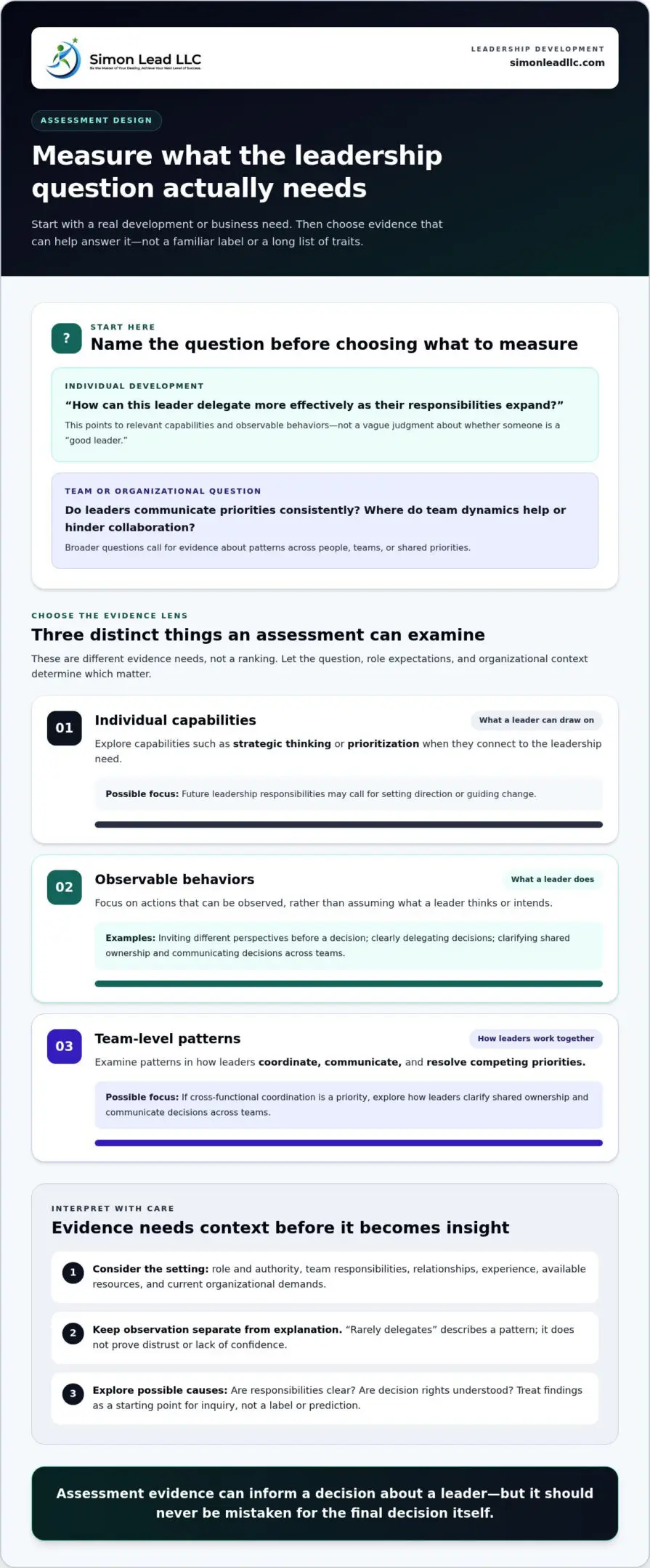
Assessment evidence can inform a decision about a leader, but it should never be mistaken for the final decision itself.
What questions can a leadership assessment help answer?
Begin with a specific development or business question. For an individual, that might be: “How can this leader delegate more effectively as their responsibilities expand?” This points toward observable behaviors and capabilities to explore, rather than a vague judgment about whether the person is a “good leader.” A clear question also helps you decide what evidence is relevant and what a useful next step could look like.
Broader questions call for a wider view. An organization might ask whether its leadership team communicates priorities consistently, or where team dynamics help or hinder collaboration. Individual questions focus on one leader’s growth; organizational questions explore patterns across people, teams, or shared priorities. Let the question determine whose perspectives and evidence are relevant.
Who can benefit from leadership assessments?
Assessments can help individual leaders strengthen their impact, leadership teams improve how they operate, and organizational decision-makers plan development. They aren’t only for people who are struggling or being considered for a senior role. Leaders at different stages can use structured feedback to clarify what to build on and where to focus next.
Match participation to the purpose. If the question concerns one leader’s development, focus evidence on that person’s role and behaviors. If the concern is team effectiveness, examine relevant team-level patterns. Including people whose perspectives relate to the question keeps the assessment focused and makes its insights more applicable to real development needs.
What Should a Leadership Assessment Measure?
Choose what to measure after clarifying the decision or development need. Leadership assessments are most useful when their focus connects directly to a real question, rather than a tool’s familiar labels or a long list of traits. The evidence needed to develop one leader may differ from what an organization needs to understand about a team or future leadership capacity.
Keep three evidence needs distinct. Individual capabilities include areas such as strategic thinking or prioritization. Observable behaviors describe what a leader does, such as inviting different perspectives before making a decision. Team-level patterns concern how leaders coordinate, communicate, or resolve competing priorities. Role expectations and organizational context determine which dimensions matter.
An assessment should measure capabilities connected to a defined leadership need, not qualities chosen without a clear purpose.
Match assessment dimensions to the leadership question
A succession question and an individual development question call for different lenses. If the organization is planning for future leadership responsibilities, it may need to consider capabilities relevant to the role’s scope, such as setting direction or guiding change. For an individual development goal, the focus might be a behavior the leader wants to strengthen, such as clearly delegating decisions.
Start by naming the priority the leader or organization needs to advance. Then ask what people in the relevant role must demonstrate to support it. If stronger cross-functional coordination is a priority, for example, examine how leaders clarify shared ownership and communicate decisions across teams. Measuring a quality without connecting it to the goal adds information, but not necessarily insight.
Interpret findings in role and organizational context
The same behavior can carry different implications in different roles. A leader who makes decisions independently may be effective when rapid direction is needed, while a broader team role may call for more consultation. Consider the leader’s authority, team responsibilities, available resources, and current organizational conditions before deciding what a finding means.
Keep observations separate from explanations. Evidence that a leader rarely delegates describes a pattern; it doesn’t establish that the leader distrusts colleagues or lacks confidence. Those are interpretations that require further inquiry. Explore possible causes, such as whether responsibilities are clear or decision rights are understood, rather than treating assumptions as assessment findings.
- Identify the behavior, capability, or team pattern the evidence actually describes.
- Consider the role expectations and conditions surrounding that evidence.
- Seek additional context before drawing conclusions about motivation or future performance.
A single result shouldn’t stand alone as a complete judgment. Discuss findings alongside role expectations and organizational priorities to shape a more balanced development plan. If you’re considering how assessment insights might inform a personalized plan, a complimentary consultation can help clarify the questions and priorities to explore.
Which Leadership Assessment Approach Fits Your Needs?
The right format depends on the leadership question and whose perspective can help answer it. Individual, multi-rater, and team-level approaches focus on different units of analysis, so they aren’t interchangeable. Before choosing among leadership assessments, clarify what you need to understand and how the findings will inform development.
Use this comparison as a starting point. Formats differ, so consider whether a specific instrument suits your purpose and participant group, and what evidence is available about its use.
How do individual, 360-degree, and team assessments differ?
An individual approach centers on one leader. A 360-degree format gathers feedback from multiple perspectives, which can reveal differences between how a leader sees their behavior and how others experience it. That input isn’t an automatic measure of effectiveness; interpret it in light of role expectations and context. A team assessment, by contrast, looks at collective patterns. It can inform a conversation about how a group functions, but it shouldn’t be treated as an individual diagnosis.
How should you assess evidence quality and participant trust?
Consider whether the assessment suits its intended purpose and participant group, and understand what its findings can reasonably support. Before participation begins, explain why the assessment is being used, who will see the results, how information will be handled, and what confidentiality participants can expect. Clear expectations help people make informed choices and support candid participation.
Trust depends on more than the instrument. Explain how results will inform development, and avoid presenting feedback as a verdict or using it to make claims the evidence can’t support. When participants understand the purpose and access arrangements, the findings have a stronger foundation for constructive discussion.
How Do You Turn Leadership Assessment Results into Development?
Assessment findings become useful when they shape what a leader does differently at work. A report score alone can’t show whether behavior changes, so connect each priority to situations where the leader can practice and receive feedback. Keep the initial plan focused, with a manageable set of priorities that matter to the role and organizational goals.
Use this sequence to move from insight to sustained action:
- Debrief the findings. Review key themes together, clarify what the evidence does and doesn’t indicate, and invite the leader to connect it with current responsibilities.
- Select priorities. Identify the development needs most relevant to the leader’s role and organizational objectives. Choose a focused set instead of trying to address every observation at once.
- Agree on actions. Define specific behaviors to practice, the work situations where they can be applied, and what support may help. For example, a leader developing delegation might clarify decision ownership during project planning.
- Review progress. Set check-ins to discuss what’s changing, what remains difficult, and whether the actions still fit. Use agreed indicators and relevant feedback to refine the plan.
How should leaders discuss assessment findings?
A constructive debrief recognizes strengths as well as opportunities to grow. Invite the leader to test interpretations against real examples: “When did this behavior help the team?” and “What was happening when it became less effective?” These questions ground the conversation in context instead of treating feedback as a verdict. Then translate recurring themes into clear priorities and practical next steps.
Support may include executive coaching when a leader would benefit from focused reflection and follow-through, or a leadership workshop when a group shares a development need. Match the support to the priority. The aim is to make practice relevant to the work, not to add activities without a clear connection to the findings.
How can organizations track progress after assessment?
Before development begins, agree on a useful baseline and observable indicators. For a goal around clearer communication, indicators might include whether a leader consistently clarifies ownership and next steps in team discussions. Choose signals that reflect the intended behavior and are practical to revisit, rather than relying only on a new score.
Use scheduled check-ins and relevant feedback to examine progress over time. Consider whether the behavior is being applied in the situations that matter, what conditions support it, and what adjustments are needed. Organizational performance can have several contributing factors, so don’t attribute business outcomes to an assessment alone. Use measures to guide learning and evaluate the development effort.
Simon Lead LLC provides leader and team assessments that can inform personalized development plans. Explore a personalized development plan and consider how assessment findings could guide practical next steps.
How Simon Lead LLC Connects Leadership Assessments to Growth
Simon Lead LLC provides leader and team assessments to generate data-driven insights for individual development and organizational growth. Their value lies not in a report alone, but in how findings connect to leadership priorities and shape thoughtful next steps. Assessment insights can inform a personalized development plan, with measurable progress as a goal rather than a guaranteed outcome.
Start with the purpose: what leadership need are you trying to understand, and how does it relate to your organization’s priorities? This keeps the discussion relevant, whether the focus is an individual leader’s growth, a team’s effectiveness, or broader organizational capability. Assessments can inform the conversation, while the people involved provide context that helps make findings meaningful.
What to expect from an assessment-led development conversation
A development conversation explores what the assessment findings suggest, where strengths are evident, and which opportunities may deserve attention. Connect insights with relevant goals and responsibilities instead of treating results as a verdict. Leaders and decision-makers can discuss what resonates, what needs more context, and which priorities are practical to address. This turns information into an intentional direction for growth.
From there, a personalized plan can link development priorities with actions in the work itself. The right support depends on the need: executive coaching can support an individual leader’s development, while a leadership workshop can help a group focus on shared growth. These services build on assessment insights without assuming one format suits every situation.
Choose a practical next step for your leadership goals
Consider where the most important question sits. Is it about one leader’s capabilities and growth, how a leadership team works together, or the organization’s wider leadership capacity? Defining the scope clarifies whose development matters and what action may be relevant. It also connects insight directly to the priorities the organization wants to advance.
Simon Lead LLC offers leader and team assessments, executive coaching, and leadership workshops to support different parts of this development journey. Assessment findings can help inform the next step, while a tailored plan keeps attention on meaningful priorities and progress. The work is intended to support lasting organizational change, not promise a particular result from assessment alone.
If you’re ready to explore how assessment insights could inform a personalized development plan, schedule a complimentary consultation with Simon Lead LLC.
Make Your Next Leadership Move Count
The value of leadership assessments is measured not by the report they produce, but by the choices that follow. Choose one meaningful leadership priority, define what progress would look like in day-to-day work, and make time to review what’s changing. Focused action can turn insight into a stronger foundation for individual and organizational growth.
You don’t need to have every development step mapped out before you begin. A conversation about your goals can clarify where to focus and how a personalized plan may support the change you want to see. Simon Lead LLC offers leader and team assessments, with executive coaching and leadership workshops to support development priorities.
Schedule a complimentary consultation to explore a personalized development plan. Start with a clear priority and a willingness to act.
Frequently Asked Questions
Are leadership assessments scientifically validated?
Some are, but validation depends on the specific instrument and how it’s used. Look for evidence that the assessment measures what it claims to measure and suits the intended purpose and participant group. A tool designed for reflection may not be suitable for selection decisions. Ask what evidence supports its use, what its limitations are, and whether conclusions rely on the instrument alone or broader information.
Can leadership assessments predict a leader’s future performance?
No assessment can establish with certainty how a leader will perform in the future. Findings may offer information relevant to a particular role or development goal, but performance also depends on experience, responsibilities, organizational conditions, and opportunities to grow. For example, an assessment may highlight strategic thinking as a development area, but it can’t determine how that leader will respond to future challenges or changing expectations.
How often should leaders repeat an assessment?
There’s no universal schedule. Repeat an assessment when there’s a clear reason to gather new insight. A change in role, significant shift in responsibilities, or new development objective may make reassessment useful. Consider whether the chosen approach can meaningfully show change over time. To review development, combine assessment findings with ongoing feedback and examples from work rather than relying on repeated scores alone.
Who should participate in a leadership team assessment?
Include people whose roles and interactions are relevant to the question being explored. If the focus is how a leadership group makes decisions together, participation should reflect the group’s actual working relationships and responsibilities. Clarify who is included and why before beginning. A carefully defined participant group keeps findings relevant and avoids collecting information from people without a meaningful connection to the team’s work.
Are leadership assessment results confidential?
Confidentiality depends on the assessment arrangement, so clarify expectations before anyone participates. Explain who can access individual responses, whether findings will be shared in a report or discussion, and how the information will be stored and used. Don’t assume that “confidential” means the same thing to everyone involved. Participants should understand these boundaries in advance so they can make informed choices about sharing their perspectives.
Can a leadership assessment identify high-potential employees?
An assessment can contribute useful information to a broader discussion about development potential, but it shouldn’t determine someone’s future from a single result. Consider findings alongside the person’s work experience, demonstrated capabilities, interests, and the requirements of possible future roles. For example, strength in strategic thinking may be relevant to a broader role, but the organization should also consider whether the employee has opportunities to demonstrate and develop that capability.
What should leaders do if they disagree with their assessment results?
Raise the disagreement and explore the specific findings rather than accepting or dismissing them immediately. Ask what examples or perspectives informed the result, then compare those observations with recent work situations. A leader might recognize a behavior in one setting but not another, or identify circumstances that shaped how it appeared. Treat the difference as a prompt for discussion and further evidence, not as proof that either perspective is automatically correct.