
Executive Coaching vs. Mentoring: Which Path Unlocks Your Highest Leadership Potential?
What if the very wisdom that propelled you to the C-suite is the exact barrier preventing your next evolution? Many high-level decision-makers find themselves isolated at the summit, possessing the technical mastery of the past but lacking the internal compass for an unmapped future. This ambiguity often centers on the distinction between executive coaching vs mentoring. While both offer a necessary sounding board for the complexities of leadership, they operate through different psychological frameworks and strategic intentions.
You likely recognize the difficulty of transitioning from tactical management to visionary leadership while surrounded by conflicting industry jargon. It’s a common point of friction in professional growth. This article provides a definitive framework to help you determine which strategic partnership will unlock your latent capabilities and drive measurable organizational impact. We’ll examine the core differences in methodology, duration, and outcomes; this ensures you have the clarity to choose a path that fosters sustainable transformation and the maximization of your professional influence.
Key Takeaways
- Distinguish between the facilitated process of unlocking latent capabilities and the traditional relationship of transferring wisdom to determine your best path forward.
- Utilize a clear framework for deciding between executive coaching vs mentoring based on whether your current challenge is leadership effectiveness or industry-specific knowledge.
- Identify how professional assessments reveal the behavioral blind spots that often hinder the transition from tactical management to strategic influence.
- Learn how a structured methodology like the M.A.F.F. model ensures that individual professional evolution translates into sustainable and measurable organizational transformation.
The Fundamental Distinction: Executive Coaching vs. Mentoring
Choosing between executive coaching vs mentoring isn’t merely a matter of semantics; it’s a strategic decision that dictates the trajectory of your professional evolution. Think of the difference as a compass versus a map. A mentor provides you with a map of the territory they’ve already traversed. They share the landmarks, the pitfalls, and the shortcuts based on their own history. In contrast, an executive coach helps you build a compass. This internal tool allows you to navigate uncharted territories where no map exists, relying on your own refined judgment and behavioral agility.
In 2026, the complexity of global markets demands more than just following a predecessor’s footsteps. Leaders now face rapid AI integration and shifting organizational structures that require a high degree of self-awareness. Distinguishing between these two paths is essential for any executive who wants to move beyond tactical management. The choice hinges on whether you need to learn the “rules of the game” from an industry veteran or if you need to transform how you play the game entirely. Understanding the foundational nuances of Coaching vs. mentoring ensures that your investment in development yields a measurable return in leadership presence and organizational impact.
What is Executive Coaching?
Executive coaching is a rigorous, facilitated process designed to unlock latent capabilities. It doesn’t require the coach to be an expert in your specific technical field. Instead, the coach acts as a catalyst for behavioral transformation. They use structured frameworks and psychological insights to help you identify blind spots in your strategic presence. It’s a goal-oriented partnership. You don’t just talk about problems; you actively dismantle the habits that limit your influence. The focus remains squarely on your future potential rather than your past performance, creating a steady cadence of growth that is both sustainable and intellectually stimulating.
What is Mentoring?
Mentoring is a relationship rooted in the transfer of established wisdom and industry experience. It’s often a more informal arrangement where a seasoned professional shares their career trajectory to guide a less experienced leader. The primary value lies in the mentor’s ability to say, “This is how I handled this situation.” It’s an excellent path for those seeking industry-specific knowledge or long-term career navigation advice. While it provides a sense of security through shared experience, it focuses on external guidance rather than the internal behavioral shifts required for visionary leadership. Mentoring helps you understand the existing landscape, while coaching prepares you to change it.
Scope of Impact: Behavioral Transformation vs. Knowledge Transfer
The true impact of any leadership development initiative is measured by the depth of the change it inspires. While mentoring facilitates a horizontal transfer of knowledge, executive coaching targets a vertical transformation of the leader’s internal operating system. This distinction is vital when weighing executive coaching vs mentoring. Mentoring provides the “what” of a career, offering industry-specific insights and historical context. However, it often fails to address the deep-seated leadership inhibitors that prevent an executive from moving from tactical management to strategic influence.
Strategic influence requires a profound understanding of organizational psychology. High-level leaders often operate with blind spots that go unaddressed in informal mentoring relationships. These behavioral gaps act as “silent killers” of team performance, manifesting as communication barriers or a lack of decisiveness. By focusing on behavioral transformation, coaching ensures that the shift in leadership style isn’t just a temporary adjustment but a permanent evolution. This top-down behavioral shift is the only way to achieve sustainable organizational change that permeates every level of the business.
Organizations report an average return on investment of 600% from coaching, according to industry research, with 87% of companies reporting a positive ROI. These figures underscore the efficacy of behavioral transformation over mere knowledge transfer. When a leader’s growth is prioritized through a structured process, the entire organization benefits from a more refined strategic presence.
The Power of Data-Driven Leadership Assessments
Intuition is a valuable asset, but it shouldn’t be the sole driver of C-suite growth. Professional Leader and Team Assessments provide the evidence-based insights necessary to map a precise development plan. These tools move beyond subjective feedback to identify the specific behavioral patterns that hinder performance. When leaders have access to objective data, they can confront their challenges with a level of clarity that intuition simply cannot provide. This data-driven approach ensures that every session is anchored in reality, leading to measurable results that justify the investment in professional evolution.
Scaling Influence Across the Organization
The benefits of a structured coaching engagement are rarely confined to the individual leader. There is a significant ripple effect that occurs when an executive undergoes a behavioral shift. As you refine your strategic presence and accountability, these values naturally begin to align with the broader strategic vision of the organization. This alignment cultivates a culture of professional excellence across the entire leadership team. By scaling influence this way, the organization doesn’t just gain a better leader; it gains a more cohesive, high-performing culture that is equipped to handle the complexities of the modern market.
Executive Coaching vs. Mentoring: A Comparison Framework
Deciding between executive coaching vs mentoring requires a clear understanding of your current professional requirements. While both paths offer significant value, they serve distinct strategic purposes. Mentoring is typically a hierarchical relationship where a senior professional offers guidance based on their specific career milestones. It’s ideal for individuals seeking industry-specific insights or networking opportunities. Executive coaching, however, is a professional partnership between equals. It focuses on leadership effectiveness and behavioral agility rather than technical “how-to” advice. This distinction is critical for corporate leaders navigating high-stakes organizational complexity where past solutions no longer apply.
- Primary Objective: Coaching targets behavioral transformation and strategic influence; mentoring prioritizes knowledge transfer and career navigation.
- Relationship Dynamics: Coaches act as catalysts for change through objective inquiry; mentors act as guides through shared personal history.
- Duration and Depth: Coaching engagements are usually structured and intensive to drive specific outcomes; mentoring often provides ongoing, less formal relational support.
Who Are You Hiring For?
Choosing the right partner depends on your current stage of evolution. If you’re managing a high-stakes organizational transition or need to refine your strategic presence, an executive coach is the authoritative choice. They provide the objective distance necessary for honest growth. Conversely, seek a mentor when you need specific industry context or want to build a network within a new sector. Some visionary leaders choose to utilize both simultaneously. In these cases, it’s vital to manage the overlap by using the mentor for technical industry knowledge and the coach for the behavioral development required to implement that knowledge effectively.
The ROI of Strategic Coaching
Viewing executive performance coaching as a cost is a tactical error; it’s a strategic investment in organizational health. The benefits manifest in measurable ways, such as increased retention rates, improved decision-making speed, and a more resilient corporate culture. These “soft” metrics translate directly into bottom-line performance. Organizations report an average return on investment of 600% from coaching, illustrating its power as a catalyst for professional excellence. This high yield confirms that when leaders optimize their latent capabilities, the entire enterprise experiences a state of enhanced performance and lasting impact.
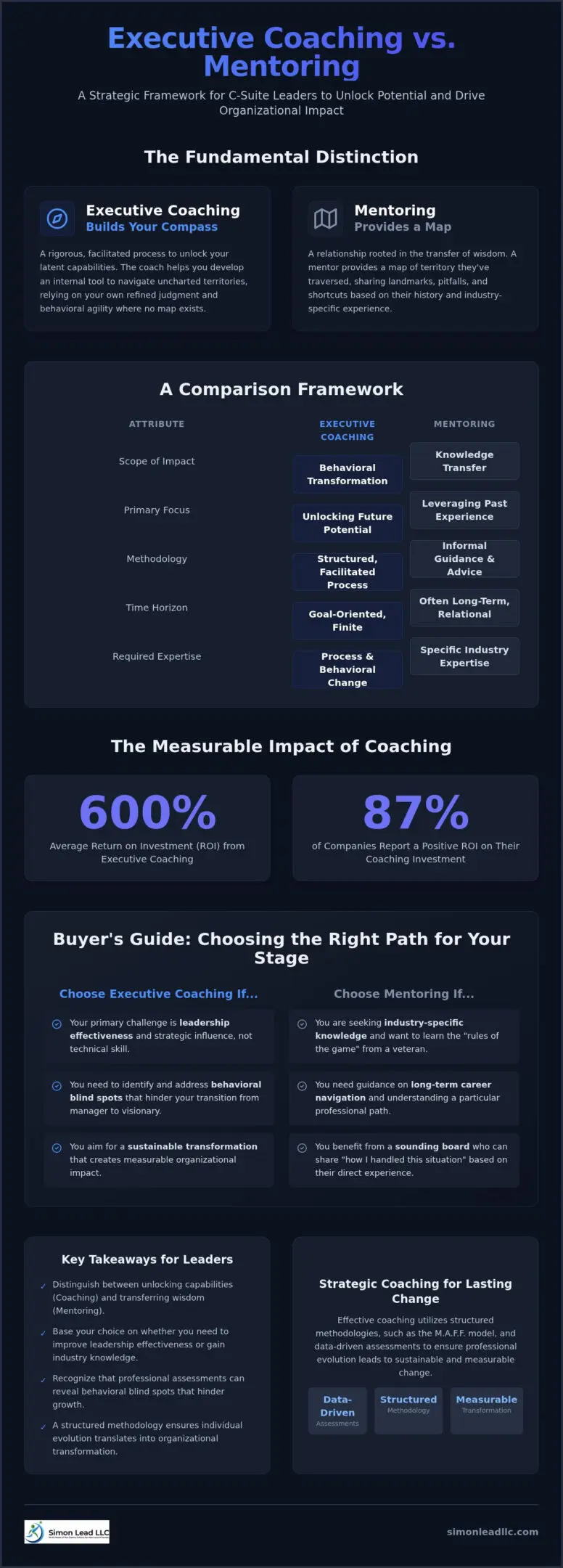
Buyer’s Guide: Choosing the Right Path for Your Stage
Determining the optimal path for your professional evolution requires a high degree of intellectual honesty. The decision between executive coaching vs mentoring often boils down to identifying your current bottleneck. Is your growth stalled by a lack of industry-specific knowledge, or are you facing a plateau in your leadership style and strategic presence? If you find yourself asking “what” to do next in a technical sense, a mentor’s map is invaluable. However, if the challenge is “how” to lead through complexity, you require the facilitated transformation of a coach. Look for a partner who brings professional authority and industry gravitas to the table. A coach should act as a catalyst for change, not merely a cheerleader for your current habits. This is why evaluating their methodology is critical. Does the practitioner utilize a structured framework like the M.A.F.F. Model to ensure measurable results, or is their approach purely anecdotal?
Assessing Your Leadership Objectives
Reflect on whether you’re struggling with tactical execution or the embodiment of visionary leadership. Defining measurable results at the outset prevents the engagement from becoming a vague exercise in self-reflection. You must also consider the format that best serves your organizational context. While a one-on-one Coaching Package offers deep, personalized evolution, a Leadership Workshop may be more effective for aligning an entire team with a new strategic vision. This choice depends on whether the primary need is individual behavioral shift or collective cultural alignment.
Evaluating Credentials and Experience
An executive-level coach needs a firm foundation in organizational development and psychology. This expertise allows them to maintain the objective distance necessary for honest growth. During your initial chemistry session, prioritize finding an alignment of vision and values. A complimentary consultation is the perfect time to ask about their experience with high-stakes transitions and how they handle behavioral resistance. You aren’t just hiring a consultant; you’re selecting a strategic partner for your professional evolution. The right expert will challenge your assumptions and provide the data-driven insights you need to lead with renewed clarity.
To gain immediate clarity on your development needs, schedule a complimentary consultation with an expert who understands the complexities of the C-suite.
The Simon Lead Approach: Strategic Coaching for Lasting Change
While understanding the theoretical differences between executive coaching vs mentoring is a necessary first step, achieving a state of optimized performance requires a structured application of those principles. Simon Lead LLC bridges the gap between individual professional evolution and sustainable organizational health. We don’t offer generic advice or anecdotal guidance. Instead, we function as a catalyst for change, utilizing a disciplined philosophy that transforms how you perceive and exercise influence. Our approach is rooted in the belief that leadership excellence is not an innate trait but a refined capability developed through rigorous, data-driven methodology.
The distinction between a mentor’s guidance and our coaching lies in the intentionality of the process. A mentor shares a history; we help you create a future. By focusing on the maximization of influence and the realization of latent capabilities, we ensure that your professional standing is built on a foundation of behavioral agility and strategic clarity. This methodical focus allows high-level decision-makers to move beyond current challenges toward a state of lasting impact.
Simon Lead LLC’s M.A.F.F. Model: Strategy Meets Organizational Psychology
At the core of our practice is the proprietary M.A.F.F. Model. This signature framework integrates the practicalities of strategic growth with the complexities of organizational psychology. By focusing on the essential pillars of leadership, the model ensures that transformation is not merely surface-level but deeply embedded in your behavioral DNA. It is specifically designed for high-potential executive leaders who require more than a mentor’s map. This model provides the intellectual rigor necessary to identify latent capabilities and align them with the broader objectives of the enterprise. The result is a measurable shift in leadership presence that can be tracked and sustained over time, providing the precision that modern executives crave.
Simon Lead LLC’s Path to Optimized Performance
The journey toward professional excellence begins with a clear-eyed view of your current standing. We utilize comprehensive Leader and Team Assessments to move beyond intuition and uncover the specific behavioral patterns that drive or hinder performance. These insights form the foundation of a personalized development plan, ensuring that every session in your Coaching Package is intentional and results-oriented. This methodical progression from assessment to implementation creates a ripple effect throughout your organization. It fosters a culture of accountability and precision that lasts long after the formal engagement concludes. Change is not only a possibility; it’s an achievable outcome of structured guidance and professional authority.
Schedule your complimentary consultation with Simon Lead LLC today to begin your transition from tactical management to visionary leadership.
Charting Your Path to Strategic Leadership Excellence
Navigating the transition from tactical management to visionary leadership requires more than just experience; it demands a deliberate choice between executive coaching vs mentoring. While a mentor provides a valuable map of past successes, an executive coach equips you with the internal compass needed to lead through future complexities. By focusing on behavioral transformation and utilizing data-driven Leader and Team Assessments, you can identify the hidden inhibitors that stall organizational progress. This shift from knowledge transfer to personal evolution is the key to achieving sustainable impact.
Success at the highest levels is rarely accidental. It is the result of structured guidance and the application of proven frameworks like our proprietary M.A.F.F. model. This methodology ensures that your professional growth translates into measurable results for your entire enterprise. If you’re ready to move beyond current limitations and maximize your professional influence, the first step is gaining absolute clarity on your development needs. Schedule a complimentary consultation to explore your personalized development plan and begin your journey toward optimized performance. Your highest leadership potential is entirely achievable through the right strategic partnership.
Frequently Asked Questions
What is the primary difference between executive coaching and mentoring?
The fundamental distinction in executive coaching vs mentoring lies in the objective. Coaching is a structured, goal-oriented partnership designed to unlock latent capabilities through behavioral transformation. Mentoring relies on a hierarchical relationship where a senior professional transfers industry-specific wisdom. While a mentor tells you how they navigated their career, a coach acts as a catalyst to help you develop the internal compass required for your own unique leadership challenges.
How do I know if I need a mentor or an executive coach right now?
Your choice depends on the specific bottleneck you face. If you require industry-specific insights or networking advice, a mentor is the appropriate choice. However, if you’re struggling to transition from tactical management to visionary leadership, an executive coach is essential. Seek a coach when you need to refine your strategic presence or address behavioral blind spots that hinder your influence. This path focuses on “how to be” rather than just “what to do.”
What should I expect in my first executive coaching session with Simon Lead?
Your initial engagement with Simon Lead LLC begins with a deep focus on clarity and data-driven insights. We utilize professional Leader and Team Assessments to move beyond intuition and identify the specific behavioral patterns affecting your performance. You can expect a high-formality environment that balances professional authority with transformative encouragement. This first step ensures your development plan is personalized and anchored in measurable results rather than vague self-reflection or generic advice.
Can an executive coach help with team performance, or is it strictly one-on-one?
Our services extend far beyond individual development to impact the entire organization. While one-on-one sessions are a core component, we also provide a structured Leadership Workshop and comprehensive Team Assessments. These tools identify the “silent killers” of team performance and align the group with a shared strategic vision. The individual evolution of a leader naturally creates a ripple effect, cultivating a culture of accountability and professional excellence across the leadership team.
How is the ROI of executive coaching measured in a corporate environment?
Measuring ROI involves tracking both qualitative shifts and quantitative business outcomes. Organizations report an average return on investment of 600% from coaching, according to industry research. We focus on metrics like executive retention, the speed of strategic decision-making, and measurable improvements in team performance data. By using a structured methodology, we ensure that individual professional growth translates directly into lasting organizational change and a state of optimized performance for the enterprise.
What makes the M.A.F.F. model different from other coaching frameworks?
The M.A.F.F. model is our signature framework that bridges the gap between individual growth and organizational performance. Unlike generic training modules, this model integrates strategic leadership excellence with the complexities of organizational psychology. It’s specifically designed for high-potential executives who require a rigorous, disciplined philosophy. By focusing on four distinct pillars of leadership, the framework ensures that transformation is sustainable and that every session drives you toward the maximization of your influence.
Do executive coaches provide tactical business advice like mentors do?
Executive coaches generally avoid providing tactical, industry-specific “how-to” advice. Instead, they function as an objective sounding board to help you refine your own judgment and strategic presence. While a mentor shares their personal history to guide your steps, a coach uses reflective inquiry to challenge your assumptions. This process builds your internal capacity for decision-making, ensuring you can navigate uncharted territories where a mentor’s past experience might no longer be applicable.
How long does a typical executive coaching engagement last for a CEO?
The duration of an engagement is tailored to the complexity of your leadership objectives. While some specific challenges can be addressed in a shorter timeframe, a comprehensive Coaching Package typically spans several months to ensure behavioral shifts are sustainable. This steady cadence builds trust and allows for the methodical implementation of new leadership strategies. Our focus remains on achieving lasting organizational change rather than providing a quick, temporary fix for immediate tactical problems.