
Executive Coaching Packages: A Strategic Guide to Leadership Transformation in 2026
What makes executive coaching packages valuable is not simply the number of hours they include, but the leadership change they are designed to support. A calendar of sessions may look structured, yet without clear goals, a grounded approach, and a way to review progress, outcomes can be difficult to define or explain to stakeholders.
Leaders and organizations need more than useful conversations. They need a development plan that connects leadership goals to observable behaviors and organizational priorities. A data-informed approach can help make that journey more focused and give decision-makers a clearer basis for discussing progress.
This guide explains how to evaluate an executive coaching package for leadership development. You’ll learn what a structured engagement can address, how assessments can establish a useful starting point, and how to connect leadership goals with evidence of change. Simon Lead LLC offers executive coaching, Leader and Team Assessments, Leadership Workshops, and the M.A.F.F Model to support leadership development and organizational change.
Key Takeaways
- Assess executive coaching packages by the outcomes and structure they support, not simply by the number of sessions.
- Consider how leadership and team assessments can inform a focused development plan.
- Match the engagement’s duration and intensity to the leadership transition or organizational goal at hand.
- Connect coaching objectives to observable behaviors and organizational measures to make progress easier to evaluate.
- Consider how Simon Lead’s M.A.F.F Model can guide leadership development and organizational change.
Beyond the Hourly Rate: Defining the Modern Executive Coaching Package
A single coaching session can help a leader think through a pressing decision. A package connects reflection to ongoing development. Executive coaching is a strategic partnership in which a leader works with a coach to strengthen effectiveness, clarify priorities, and translate insight into action. Business coaching, also known as executive coaching, offers support and guidance to improve personal effectiveness in a business setting.
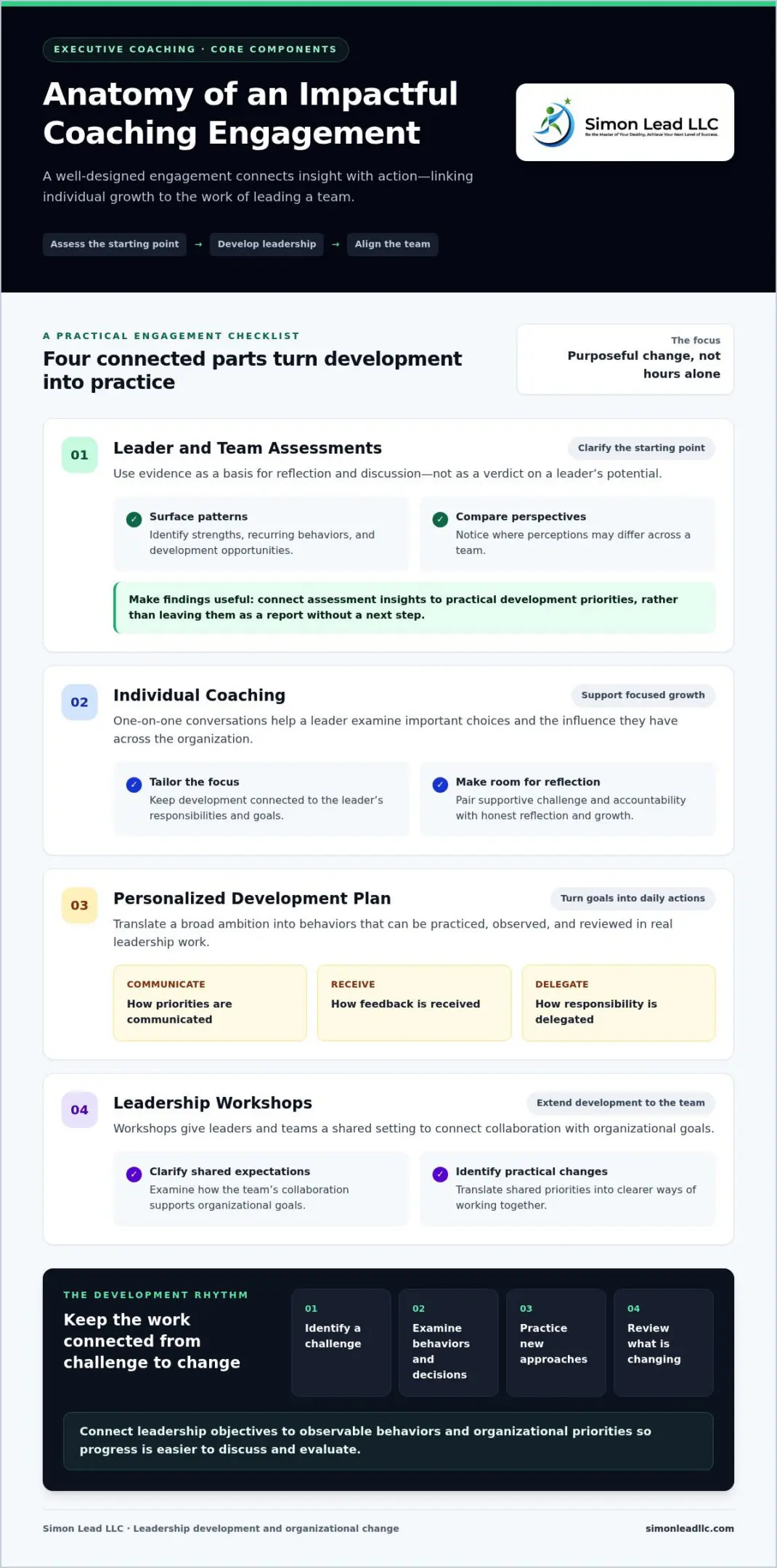
That distinction matters. Buying hours treats development as a series of separate conversations, without necessarily defining what should change or how progress will be recognized. A structured engagement starts with a leadership objective and creates a path for working toward it. The focus shifts from time spent together to a purposeful progression: identify a challenge, examine the behaviors and decisions behind it, practice new approaches, and review what is changing.
For a manager moving into an executive role, the shift can be especially important. Success may depend less on personally solving each operational issue and more on setting direction, aligning people, and influencing outcomes across teams. A coaching package can make that transition an explicit development goal, helping the leader focus on the demands of the new role rather than adapting through trial and error alone.
Why Structure Matters in Executive Development
Leadership complexity rarely yields to a quick fix. A useful development plan provides continuity, helping a leader move from self-awareness to deliberate practice and strategic execution. For example, a leader who tends to dominate discussions can set a specific goal to invite dissenting views, practice doing so in key meetings, and reflect on how it affects decision-making.
Intentionality gives each step a purpose. Instead of collecting disconnected insights, the leader can connect everyday choices to broader priorities, such as clearer accountability or stronger collaboration. This makes progress easier to observe and helps new behaviors become part of the leader’s routine, extending their impact beyond coaching conversations.
The Shift from Tactical to Strategic Influence
Executive growth involves more than resolving the urgent issue in front of you. Coaching can help leaders examine recurring patterns, consider the longer-term consequences of their decisions, and use their influence in service of broader organizational aims. The practical question becomes not only “How do I fix this?” but also “What conditions will help my team handle this well in the future?”
This broader perspective matters as leaders move from managing tasks to shaping direction. A professional coaching relationship creates space for candid reflection while keeping attention on responsibility, judgment, and follow-through. The goal is not to adopt a performance persona. It is to bring greater clarity and consistency to leadership. Well-structured executive coaching packages give leaders a path for turning that aspiration into focused, observable development.
The Anatomy of Impact: Core Components of a Premium Coaching Engagement
A well-designed coaching engagement connects insight with action. Alongside one-on-one conversations, development may draw on Leader and Team Assessments, Leadership Workshops, and a plan for applying new practices in day-to-day leadership. Each element serves a distinct purpose: assessments help clarify the starting point, coaching supports individual growth, and workshops can connect development to shared team priorities.
This combination can make development relevant to both the leader and the organization. For a senior leader working to improve cross-functional collaboration, assessment insights can help identify where communication or alignment may be breaking down. Coaching can then focus on the leader’s influence, while a workshop can help the team translate shared priorities into clearer ways of working.
The Role of Leader and Team Assessments
Assessments provide evidence for reflection, not a verdict on a leader’s potential. They can surface strengths, recurring behaviors, and areas where perceptions may differ across a team. Interpreted thoughtfully, those insights can help identify capabilities to build on and development opportunities to prioritize. They also give leaders and decision-makers a more grounded basis for discussing goals than impressions alone.
Simon Lead incorporates Leader and Team Assessments into its approach to organizational development. Their value comes from connecting findings to practical development priorities, rather than leaving the data as a report without a next step.
Personalized Development Plans
A personalized development plan turns a broad ambition, such as becoming a more effective strategic leader, into actions that can be practiced and reviewed. It should connect leadership objectives to daily decisions: how priorities are communicated, how feedback is received, or how responsibility is delegated. The coach provides supportive challenge, helping the leader stay accountable while making room for honest reflection and growth.
For executives, individual coaching offers space to examine important choices and the influence they have across the organization. The focus is tailored to the leader’s responsibilities and goals, keeping development connected to real work rather than abstract advice.
Workshops can extend development beyond the individual. They give leaders and teams a setting to examine how their collaboration supports organizational goals, clarify shared expectations, and identify practical changes to how they work together. Simon Lead’s Leadership Workshops complement its coaching and assessment offerings as part of its leadership development work.
Finally, sustainability depends on what happens after a coaching engagement ends. Leaders can define routines to continue, behaviors to monitor, and ways to revisit progress with their teams. This makes development less dependent on scheduled conversations and more embedded in everyday practice. Simon Lead’s executive coaching and leadership assessments can support a connected development approach that links individual goals with organizational priorities.
Strategic Selection: Matching Package Duration and Intensity to Your Goals
The right coaching timeline depends on the leadership challenge, not a standard calendar. A new executive may need focused support to set priorities and build trust, while a leader guiding organizational change may need time to test new approaches and learn from their effects. Executive coaching packages are most useful when the duration gives leaders room to apply insights between conversations and adjust their practice as real situations unfold.
These timeframes can serve as planning guides, rather than fixed formulas:
- Three-month intensive: A focused option for a new executive’s first 90 days, with attention to role expectations, early priorities, and alignment with key stakeholders.
- Six-month strategic engagement: A longer arc for navigating organizational change, strengthening cross-functional influence, or extending leadership impact.
- Twelve-month development journey: A sustained horizon for C-suite leaders working on legacy, leadership continuity, and organizational health.
The difference is the amount of time available to practice and reflect. Short-term support can address an immediate need, while lasting behavioral change benefits from opportunities to try new approaches, receive feedback, and adjust. A well-paced engagement connects these steps to the demands of the leader’s role.
Evaluating the 90-Day Transition Package
A new executive’s first 90 days often involve learning the organization while setting a credible direction. Coaching can help clarify stakeholder expectations, identify opportunities to build trust, and shape an executive presence that feels authentic. Rather than trying to change everything at once, the leader can select practical priorities, define what progress would look like, and use those priorities to shape a personalized development plan.
The 6-Month Framework for Organizational Excellence
For Directors and VPs, leadership often means managing complexity across teams, priorities, and levels of the organization. A six-month horizon can provide room to consider assessment insights, work on specific behaviors, and apply new approaches across departments. For example, a leader seeking stronger alignment might practice communicating strategic priorities consistently, then observe whether teams understand how their work connects to those goals.
At the C-suite level, a longer development horizon can support reflection on the culture and leadership practices a leader wants to sustain. The focus may include organizational health, decision-making, and the development of leadership influence across the organization. These are not one-time adjustments. They benefit from deliberate practice and periodic review.
To choose thoughtfully, start with the outcome you need, then consider how much time the leader will need to practice and review progress in the flow of work. The M.A.F.F Model and Leader and Team Assessments can help connect individual development with broader organizational change, keeping the coaching journey grounded in leadership priorities rather than duration alone.
Quantifying the Intangible: Measuring ROI and Organizational Excellence
Leadership growth can feel personal, but its organizational value should be examined through observable evidence. Confidence matters most when it changes how a leader communicates, makes decisions, or supports team performance. To evaluate executive coaching packages responsibly, define success before the engagement begins, then compare relevant indicators over time rather than relying on satisfaction alone.
Start by clarifying the purpose of the investment and who needs to see progress. If the goal is stronger cross-functional leadership, identify behaviors that demonstrate better alignment and measures that may reflect its effects. Many factors can influence business outcomes, so avoid attributing every change to coaching alone. Look for a credible contribution, not a guaranteed return.
Evidence-Based Growth Metrics
Establish a baseline using relevant assessment findings, performance feedback, or existing team measures. Then translate broad objectives into behaviors that can be observed and revisited. A leader aiming to build trust might practice communicating decisions consistently and inviting concerns early. Progress can be explored through follow-up feedback from peers and direct reports, alongside evidence of how the team works toward its goals.
Use a balanced set of indicators:
- Leading indicators: New behaviors practiced, such as clearer delegation or more consistent follow-through.
- Lagging indicators: Changes in team performance scores, retention patterns, or strategic goal attainment.
- Qualitative evidence: Feedback and examples that help explain what changed, where, and for whom.
Trust can be weakened by unclear expectations, inconsistent decisions, or avoiding difficult conversations. Rather than treating trust as an abstract score, identify which behaviors are creating friction, agree on alternatives, and review feedback for signs of change. Leader and Team Assessments can help ground this inquiry in evidence and connect individual development with broader organizational health.
The Long-Term Value of Strategic Clarity
Misalignment and executive burnout can disrupt decision-making, collaboration, and progress on strategic priorities. Coaching cannot remove every organizational pressure, but it can give a leader a confidential space to examine choices, notice patterns, and respond with greater intention. A coach can offer candid challenge from outside the organization’s internal dynamics.
To evaluate longer-term value, revisit agreed measures after the engagement and consider whether useful practices continue without regular coaching conversations. Are priorities clearer? Do teams understand how their work contributes to shared goals? Are leaders sustaining the behaviors they set out to develop? These questions help decision-makers assess whether growth is taking root, while recognizing that lasting change depends on continued practice and organizational context.
Simon Lead’s Leader and Team Assessments support a data-informed view of leadership and organizational change. Executive coaching and assessments from Simon Lead can help connect defined objectives with meaningful measures and clarify organizational development priorities.
The Simon Lead Approach: Integrating the M.A.F.F Model for Lasting Results
A framework can give leadership development direction while connecting it to the realities leaders face every day. Simon Lead LLC uses its M.A.F.F Model in executive coaching and organizational change to support leaders working through current challenges and toward more effective performance. The model is part of an approach that brings coaching and Leader and Team Assessments together around meaningful development priorities.
The M.A.F.F Model provides a framework for leadership development. Its role is to guide a purposeful process while keeping attention on the leader, the team, and the organization. Rather than treating each leadership challenge in isolation, coaching can help leaders reflect on how their choices affect colleagues, priorities, and the culture they shape.
Applying the M.A.F.F Model to Your Leadership Journey
Every leadership journey begins in a distinct context. One executive may need to strengthen influence across departments; another may be working to build alignment around organizational change. The M.A.F.F Model offers a framework for supporting that development. Leader and Team Assessments can add evidence to the conversation and help ground goals in insight rather than assumption. Coaching can then focus on turning priorities into intentional leadership practice.
This approach pairs reflection with action. Leaders have space to examine difficult decisions honestly, while keeping attention on how insight informs their choices. The aim is not simply to resolve an immediate issue, but to help executives develop the perspective and influence to address challenges with greater intention over time.
Your Path to Optimized Performance
Executive growth rarely happens in a vacuum. One-on-one coaching gives senior leaders room to consider complex responsibilities, while Leadership Workshops can extend development to teams working toward shared goals. Together, these offerings connect individual reflection with the collective conditions that shape organizational performance. The focus is on meaningful, sustainable change, not a temporary lift that disappears when scheduled sessions end.
For decision-makers, a useful next step is to articulate what success should look like before shaping a coaching engagement. Consider the leadership challenge, who is affected, and what observable signs would indicate progress. Those questions give a development plan practical focus and make its relevance easier to communicate to stakeholders. Simon Lead’s approach brings structure to this work while recognizing that each leader and organization has its own context.
Executive coaching packages can provide a structured path for this kind of growth, combining individual development with attention to the broader organization. Simon Lead LLC offers executive coaching, Leadership Workshops, Leader and Team Assessments, and the M.A.F.F Model to support leadership development. Explore executive coaching with Simon Lead LLC to discuss your leadership priorities and development goals.
Shape Your Next Stage of Leadership Growth
The next step is to turn leadership ambition into a deliberate choice: identify the change that matters most, decide who it should benefit, and commit to putting new insight into practice. That clarity can help ensure your investment in executive coaching packages serves a meaningful purpose beyond the coaching engagement itself.
Simon Lead brings the M.A.F.F Model, data-driven Leader and Team Assessments, and a focus on measurable organizational results to leadership development. Together, these elements can help you approach growth with intention and keep attention on the outcomes that matter to your organization.
What would stronger leadership make possible for your team? Schedule a complimentary consultation with Simon Lead LLC to discuss your priorities and explore a personalized leadership development plan.
Frequently Asked Questions
What is typically included in an executive coaching package?
An executive coaching package typically centers on one-on-one coaching, agreed development objectives, and a way to review progress. Depending on the leader’s needs, development may also include Leader and Team Assessments or a Leadership Workshop. For example, an executive working to improve communication across departments might combine individual coaching with team-focused development. The right mix depends on the goals, participants, and organizational context.
How long does a standard executive coaching engagement last?
There isn’t one standard duration that fits every leader. The timeline depends on the development goal, how much opportunity the leader has to apply new approaches, and when progress should be reviewed. A focused transition may call for a different timeframe than broader organizational change. Set clear milestones at the outset, then use review points to decide whether the pace still supports the engagement’s purpose.
What is the difference between executive coaching and leadership training?
Executive coaching is tailored to a leader’s role, decisions, and development needs, while leadership training generally teaches concepts or practices to a group. A workshop can introduce shared approaches, but coaching gives an individual room to examine how those ideas apply in a specific situation. For instance, a leadership team might learn a common communication framework together, while an executive uses coaching to work through a particular challenge in applying it.
How do I measure the ROI of an executive coaching package?
Measure ROI by linking the engagement to a defined organizational objective and tracking relevant evidence before and after. If the priority is better decision-making, examine whether decision ownership becomes clearer and whether teams report fewer delays caused by ambiguity. Pair those observations with performance or assessment data where appropriate. Record other factors that may influence results so stakeholders can distinguish coaching’s contribution from broader organizational changes.
Can coaching packages be customized for entire leadership teams?
Yes. Development can address shared team priorities through Leadership Workshops and Leader and Team Assessments, alongside individual executive coaching where useful. For example, a leadership group working through competing priorities could focus together on alignment, while its members address role-specific goals individually. This combination connects individual development with how the team works, rather than treating organizational challenges as unrelated individual issues.
What should I look for when comparing different coaching firms?
Look for a clear connection between the coaching approach, your organization’s objectives, and the evidence used to assess progress. Consider whether the methodology offers a coherent path rather than disconnected conversations, and whether development can address both individual leadership and team needs. Simon Lead uses the M.A.F.F Model and data-driven Leader and Team Assessments to connect leadership development with organizational change and measurable results.
How often are coaching sessions held within a premium package?
Session frequency varies with the engagement’s goals and the leader’s capacity to apply learning between meetings. Some coaching arrangements use weekly or biweekly sessions, while others follow a different rhythm. A useful cadence leaves enough time to test an approach in real work, reflect on what happened, and decide what to adjust. The schedule should support consistent momentum without turning coaching into meetings disconnected from leadership practice.
Is an assessment always necessary before starting a coaching program?
No. An assessment can be useful when development involves behavioral patterns, team dynamics, or differing stakeholder perspectives, but it isn’t the only way to begin. A leader can start by clarifying a specific challenge and defining what progress would look like. Assessments can add structured evidence when it would sharpen the development focus. The decision should reflect the coaching objective and the information needed to guide it.